Why Human Tutors Still Matter in Online Learning (2026)


Online learning platforms and AI educational tools advance rapidly. By 2026, digital learning will be ubiquitous, with AI tutors and VR classrooms. The global EdTech market projects significant growth, reaching £445.94 billion by 2029. Do human tutors still hold relevance? In advanced online education, human tutors vs online learning poses a key question. Despite efficient learning, human tutors offer irreplaceable value. They provide guidance, accountability, and positive academic outcomes for students. Human connection in education, exemplified by quality human tutor services like suited tutor in Oxford, offers benefits technology cannot replicate for students and the learning community.
The Enduring Value of Human Tutors: Beyond AI's Reach
Personalised Learning & Adaptability
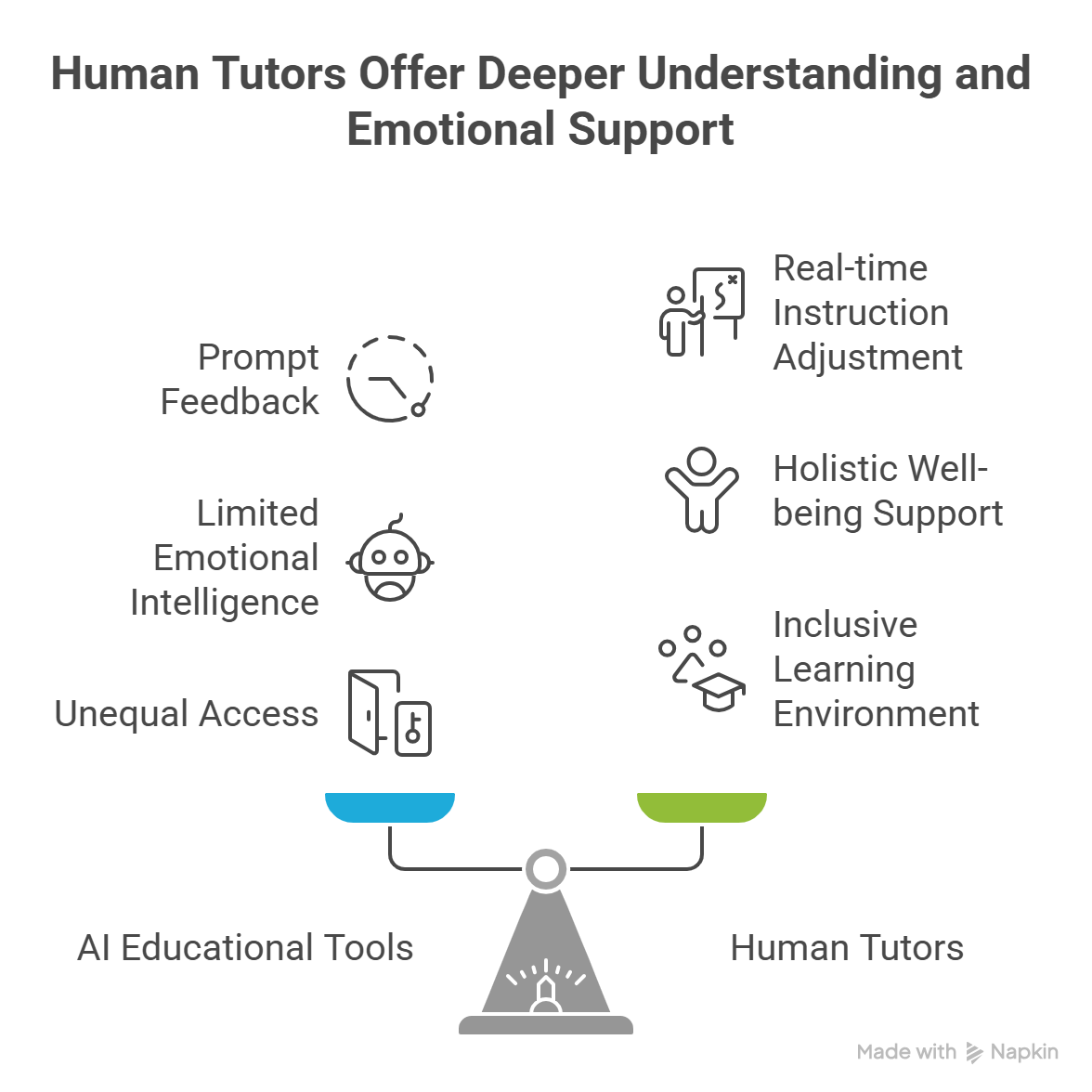
You might think AI offers the ultimate in personalised learning. It can adapt content based on your progress. However, AI educational tools have documented limitations. They often provide prompt feedback but did not indicate computational errors, requiring human intervention for deeper understanding. You risk overreliance on AI, bypassing foundational learning processes. This hinders skill acquisition. AI tools can also produce incorrect references or repetitive content, limiting reliability and novelty. Equity and access challenges exist too:
Unequal access to AI tools (especially premium versions) risks widening educational disparities.
Biases within AI systems (from skewed training datasets) can reinforce societal inequalities.
Data privacy risks arise when you input student or institutional data into AI tools.
Bias in datasets (e.g., anti-Black bias, gender bias) leads to algorithmic assessment errors and wrongly restricts learner results.
Lack of regulation in AI in EdTech raises questions about data ownership and the ability to port learning experiences.
Inequity of access and inclusion threatens to widen the digital divide due to cost barriers (paywalls) for AI tools.
Language and geography barriers exist, with most AI tools performing best in English and lacking sufficient data in other languages or non-English contexts, perpetuating global knowledge and access inequities.
There is a risk of AI-enabled learning causing more harm at scale if used to optimise a failing system.
A human tutor, however, truly adapts. They observe your subtle cues, your frustrations, and your moments of insight. This allows them to adjust their instruction in real-time. This is where human tutors vs online learning shows a clear difference. They do not just follow an algorithm; they understand you.
Emotional Intelligence & Holistic Support
Beyond academic content, human tutors offer something AI cannot: emotional intelligence. They provide holistic support that addresses your well-being. As Tutor Doctor states:
At Tutor Doctor, we believe in holistic education that goes well beyond academics and the classroom. Your human tutor gets to know you. They understand how you learn, what you struggle with, and what helps you thrive. They can:
Spot knowledge gaps that AI tools may miss.
Change pace or approach based on your mood or progress.
Offer encouragement and build confidence in ways a machine never can.
Liaise with parents and schools to ensure full-circle support. AI makes learning more efficient, but tutors make it more meaningful. They push you when needed or offer reassurance when confidence dips. Most importantly, they are real people who care about helping students succeed. This human connection builds strong relationships, fostering a supportive learning community. This kind of support is vital for your overall education.
Fostering Critical Thinking & Problem-Solving
Human tutors excel at fostering critical thinking and problem-solving skills. They do not just give you answers. They guide you through the process of discovery. They use specific pedagogical techniques to achieve this. They encourage open-ended projects, allowing you the freedom to create and express creativity. This fosters immersive and self-directed learning. Tutors model critical thinking daily. They pose questions and provide tools to help students confidently transition their skills. Connecting activities to current events broadens their impact. They embrace questions, moving beyond traditional Q&A. Tutors cultivate conversations that delve into your interests and contemporary issues. This encourages you to share thoughts on real-life events. This fosters a sense of belonging conducive to critical thinking.
Tutors use inquiry-based approaches, like the Socratic method, to encourage critical engagement with learning material. They employ dialogic teaching, fostering rich, reciprocal conversations. This is more challenging in larger classroom settings. Reflective practices guide you to think more deeply. You make connections and develop confidence in questioning information. You learn to ask, 'Is this true? What’s missing? What do I think?' Expert tutors tailor Socratic questions to you individually. This promotes intellectual curiosity and prioritises long-term mastery over quick memorisation. They encourage critical reflection using open-ended questions and case studies. They promote dialogue and collaboration through discussions and sharing viewpoints. Integrating real-world issues connects your learning to broader social contexts. This allows students to apply critical thinking to real challenges. This comprehensive instruction provides an impactful education. It gives you the experience of true discussion-based learning and valuable feedback.
The Lasting Impact of Human Tutors: Beyond AI
The Power of Human Connection in Learning

You might wonder how human interaction truly impacts your learning journey. The unique benefits from direct human interaction drive your engagement, motivation, and accountability. This section explores how human connection thrives in education, offering advantages that purely digital platforms cannot replicate.
Building Rapport & Trust
Building rapport with your tutor creates a powerful foundation for learning. When you feel a genuine connection, you are more open to new ideas and challenges. Psychological studies consistently show a strong link between the rapport educators and students share and positive student outcomes. These outcomes include improved attitudes, motivation, enhanced perceived learning, overall well-being, and academic achievement. This positive rapport is especially important for disadvantaged students, offering significant benefits in their learning journey.
Consider these findings on rapport:
Wilson and Ryan (2013) developed a Professor–student rapport scale. They found six items predict student outcomes, directly linking rapport to learning.
Frisby and Martin (2010) explored instructor–student and student–student rapport in the classroom, highlighting its significance.
Gelbach et al. (2016) investigated how leveraging similarity can improve teacher–student relationships and academic achievement. This demonstrates a psychological mechanism for enhanced learning.
Worley et al. (2007) studied instructional communication competence, drawing lessons from award-winning teachers. This often involves strong rapport.
Dwyer et al. (2004) developed the Connected Classroom Climate Inventory. It focuses on communication and connectedness, which are integral to rapport.
Burke-Smalley (2018) presented rapport as a key element in creating an effective learning environment, bridging practice and research.
Trust also plays a vital role. When you trust your human tutor, you are more likely to take academic risks, ask questions, and explore new concepts. This trust enables a supportive learning environment. You are more likely to complete tasks you initially question if you trust your teacher has your best interests at heart. This leads to increased compliance in future assignments. Studies show that when students trust their teachers, they exhibit higher engagement in learning activities. They actively seek feedback and participate more in class discussions (Roorda et al., 2011). Effective communication and collaboration between students and educators are facilitated by trust.
Collaborative learning and positive student-teacher relationships are crucial for engagement. This reflects social development theory.
Human knowledge grows from relationships. This emphasises the value of social learning and language in building trust, as highlighted by Kalanathi.
Trust, like respect, is earned. It is well-documented as important in leadership and education. It contributes to academic engagement, pastoral care, and preparation for future roles.
Real-Time, Nuanced Feedback
Human tutors provide real-time, nuanced feedback that goes beyond what AI can offer. An AI system might correct a grammatical error, but a human tutor understands the context of your writing. They can explain why a particular phrasing is unclear or suggest alternative ways to express your ideas. This is where human tutors vs online learning shows a significant difference. AI systems struggle with 'learner accountability'. This is a key benefit of real-life tutoring. Additionally, 'emotional intelligence and empathy will also remain difficult to replicate fully' by AI tutors. These are examples of nuanced feedback elements that a human tutor provides. AI currently struggles to generate these. Your tutor can read your body language, sense your confusion, and adjust their feedback accordingly. This personalised approach ensures you receive the most effective guidance.
Mentorship & Accountability from Tutors
A human tutor acts as a mentor, offering guidance and holding you accountable for your progress. They do not just teach subjects; they help you develop study habits, set goals, and navigate academic challenges. Mentors provide accountability and motivation to succeed. They monitor your academic progress and wellness, including Attendance, Behaviour, Classwork, and Wellness (ABCW) daily. Research indicates that students who meet regularly with mentors are 52% less likely to skip school and 37% less likely to skip a class. This demonstrates improved accountability. Mentored youth are 55% more likely to enrol in college, showing improved goal achievement.
Mentors develop individualized success plans with students. These cover interests, dream careers, academic goals (e.g., GPA), and progress goals in subjects like maths and English.
Mentors use these success plans to hold students accountable. They engage in conversations about current progress towards stated goals (e.g., 'Are you earning the 3.0 GPA goal?').
Mentors have access to grades and test scores to facilitate these accountability discussions.
Mentors can also communicate with teachers, parents, counsellors, and principals to support student progress towards goals.
This mentorship creates a strong relationship, fostering a sense of responsibility and driving you towards your goals.
Why Human Connection Boosts Engagement
Human connection significantly boosts your engagement in learning. When you feel seen, supported, and valued, you are more motivated to participate and learn. Decades of educational research confirm that students learn best when they feel seen, supported, and valued. An American Psychological Association study indicates that students with positive teacher-student relationships show stronger academic motivation and higher achievement. An Educause report found that students in live virtual classrooms report higher satisfaction and retention rates compared to asynchronous programmes. An article by the Harvard Graduate School of Education highlights that strong peer relationships significantly improve students’ self-esteem, resilience, and academic persistence.
Research consistently demonstrates that a sense of belonging is paramount for psychological engagement and overall student success. Ensuring that students feel “seen, heard and valued” is a key determinant of psychological engagement. It is a prerequisite for all other forms of learning to take root. This genuine connection creates a vibrant community where you feel comfortable asking questions and sharing ideas. This relationship-driven experience makes learning more enjoyable and effective. The power of human connection thrives in environments where authentic relationships are prioritised.
Human Tutors vs Online Learning: Bridging the Gaps

You might wonder where human tutors fit in a world increasingly dominated by online education. This section directly compares the strengths of human tutors against the limitations of purely online or AI-driven learning. It shows where human intervention remains essential. It also acknowledges AI's role in reducing barriers, allowing educators to focus on higher-touch activities.
The Human Touch in Online Education
Addressing Diverse Learning Needs
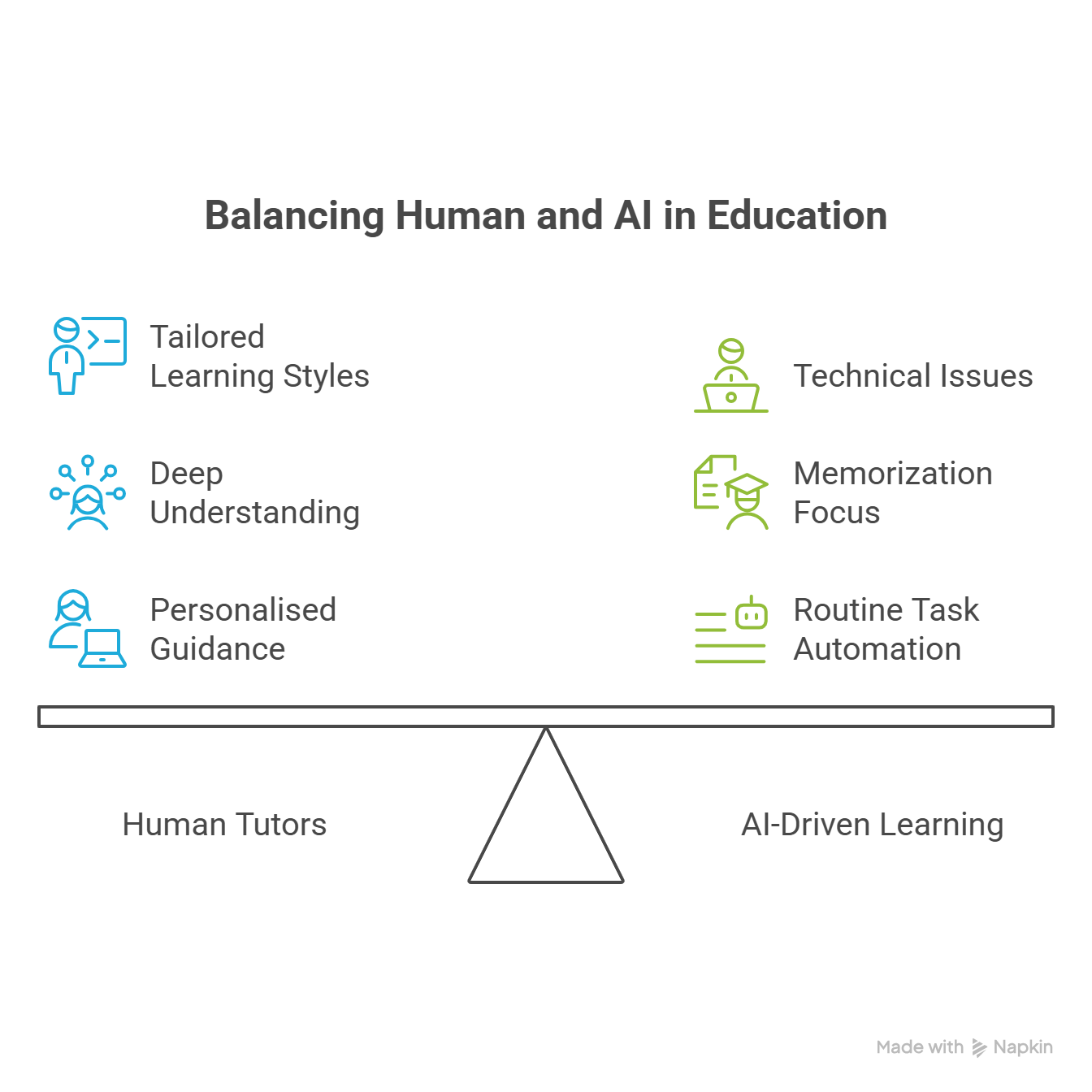
Online learning faces challenges in meeting all students’ needs: technical issues, isolation, motivation, time management, and accessibility barriers. Students with different learning styles or special needs may struggle without tailored support.
Human tutors excel here. They adapt teaching methods to individual learning styles, pace, and cultural backgrounds. Using visual, auditory, and hands-on approaches, they provide personalised guidance, foster collaboration, and ensure every student can engage effectively. Tutors create inclusive, flexible learning environments that online platforms alone cannot fully replicate.
Navigating Complex Subjects with Insight
Some subjects require more than memorisation—they demand deep understanding. Human tutors guide students through complex ideas, provide context, and connect theory to real-world meaning. Unlike AI, tutors adapt explanations in real time, spot misunderstandings, and use analogies until concepts truly click. This personalised insight is essential for mastering challenging subjects.
The Complementary Role of Tutors in an AI World
The future of education isn’t human tutors versus AI—it’s how they work together. AI tools automate routine tasks like lesson planning, grading, and content creation, giving tutors more time to focus on what matters most.
With AI handling efficiency, human tutors provide personalised guidance, critical thinking support, and meaningful learning relationships. Tutors also use AI insights to identify learning gaps, tailor instruction, and support students in real time.
This partnership delivers the best of both worlds: smart, data-driven learning powered by AI, combined with the empathy, adaptability, and insight only human tutors can offer.
Human tutors are not replaced; their role in education is evolving. The human tutors vs online learning debate highlights their crucial place in a hybrid educational system. You gain personalised support, emotional intelligence, and human connection. Tutors provide nuanced feedback and accountability for students. This blend of technology and human teachers builds strong relationships, boosting student learning and engagement. This creates a thriving community through genuine connection. Consider a human tutor's impact on your academic growth and educational experience.
See Also
Modern Tutoring's Ascent: Transforming Education for the Next Generation
One-to-One Tutoring in 2025: A Glimpse into its Future
Online Versus Classroom Learning: A Comprehensive View for All Stakeholders
AI Tutors Explained: A Parent's Essential Guide to Future Learning
Suited Tutor: Award-Winning Support for UK Students, Online and In-Person