What Are the 11 GCSE Subjects? (A Complete Student’s Guide to Smart Choices)

Understanding GCSEs: Your First Real Academic Milestone
Choosing your GCSE subjects shouldn’t feel like standing in front of a wall of doors with no labels — but for most students, that’s exactly what happens. One minute you’re excited about building your future, and the next you’re buried under pressure, second-guessing every choice:
“What if I pick the wrong GCSEs?”
“What if everyone else knows what they’re doing except me?”
“What if this affects my A-Levels… or university… or everything?”
You’re not alone.
At Suited Tutor, we’ve guided thousands of UK students through this exact moment — the confusion, the stress, the feeling that a single subject choice could shape your entire future. The truth is, GCSEs open doors, but only if you understand which ones matter for you.
This guide is here to do one thing:
👉 Turn uncertainty into clarity.
👉 Turn stress into strategy.
👉 Turn “I don’t know what to choose” into “I’m choosing what’s best for me.”
Below, you’ll discover the 11 most common GCSE subjects, what each one actually involves, and how to pick a combination that supports your confidence, your strengths, and your long-term goals — without losing your sanity along the way.
At Suited Tutor, our professional tutors support thousands of GCSE learners every year, and we’ve seen firsthand how the right subject choices boost confidence, grades, and long-term opportunities.
How Many GCSEs Do Students Take (and Why 11 Is the Sweet Spot)
Most students in England take between 9 and 11 subjects.This naturally leads to questions like “Are 11 GCSEs good?” and how GCSE subject combinations influence future A-Level routes. Eleven is a popular number because it gives you a healthy mix — the core subjects you must take and a few optional ones that showcase your personality or career interest.
Some schools (like St. Mary’s Academy in Kent) even let ambitious students add an extra GCSE in languages or statistics. Others prefer to keep things manageable to maintain strong grades.Before deciding, it helps to understand the difference between optional subjects and the compulsory GCSE subjects UK students must take.
The Core GCSE Subjects (You Can’t Skip These!)
You can think of these as your academic spine — the must-have qualifications every student needs to progress.
The list below covers the compulsory GCSE subjects UK schools require for all students, regardless of academic ability.
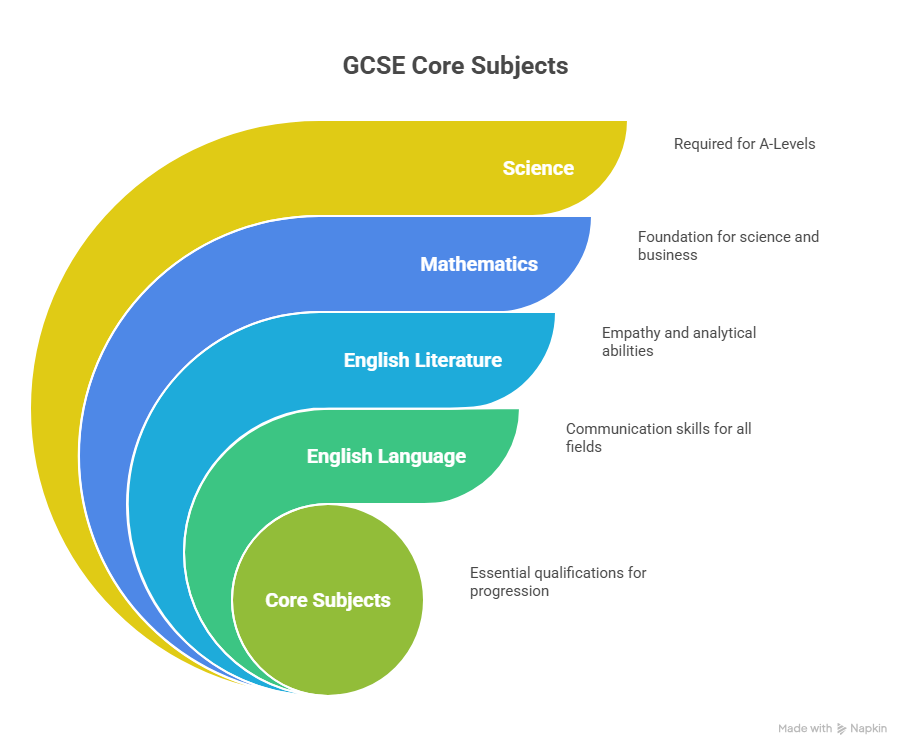
Science GCSEs: Double or Triple Trouble?
Mini-Table: Combined Science vs Triple Science
Here’s where it gets interesting. You’ve got two main paths:
Combined Science (Double Award): Covers Biology, Chemistry, and Physics together — counts as 2 GCSEs.
Triple Science (Separate Sciences): Three distinct subjects, earning 3 GCSEs.
If you dream of becoming a doctor, engineer, or lab researcher, Triple Science is your ticket 🎫. It digs deeper into experiments and theory.
Many students come to Suited Tutor unsure whether they’re ‘ready’ for Triple Science. With the right support, we’ve helped learners who doubted themselves thrive in the more advanced route — but we’ve also guided others toward Combined Science when it better fit their academic profile.
When comparing Combined and Triple Science, many students look for GCSE options advice to decide which route aligns with their strengths and long-term goals.
Curious about the difference? The BBC Bitesize Science Guide gives an excellent breakdown of both paths.
The Humanities: Learning From People and Places
Next up — History and Geography, the heart of the humanities.
History: From medieval Europe to World War II, you’ll analyse how human choices shaped the world.
Geography: Think volcanoes, migration, climate — and how they tie to economics and sustainability.
These aren’t just “memory subjects.” They train your critical thinking, writing, and argumentation — essential for careers in law, journalism, or politics.
Both subjects play an important role when building well-rounded GCSE subject combinations, especially for careers in law, journalism, or public policy.
Future Career Pathways with Humanities
History → law, journalism, politics, archaeology, public policy
Geography → sustainability, environmental science, urban planning, disaster management
Both subjects → academic research, civil service, international development
Languages: Your Passport Beyond the UK 🌍
Why a Language GCSE Strengthens Your Profile
Shows strong memory & communication skills
Helps with university competitiveness
Supports international career paths
Pairs well with humanities or business subjects
Most schools encourage you to take at least one Modern Foreign Language (MFL). Common options include:
French 🇫🇷
Spanish 🇪🇸
German 🇩🇪
Mandarin Chinese 🇨🇳
A language GCSE shows cultural awareness and adaptability — skills valued by global employers and universities alike.
A language GCSE also strengthens GCSE subject combinations for students planning to study abroad or pursue international careers.
Where a Modern Foreign Language Can Take You
Business & International Trade
Diplomacy & Foreign Affairs
Aviation & Tourism
Translation & Linguistics
Creative GCSE Subjects: Let Your Imagination Breathe
You don’t have to be Picasso to love creative subjects. Art, Design, Music, and Drama allow you to express who you are.
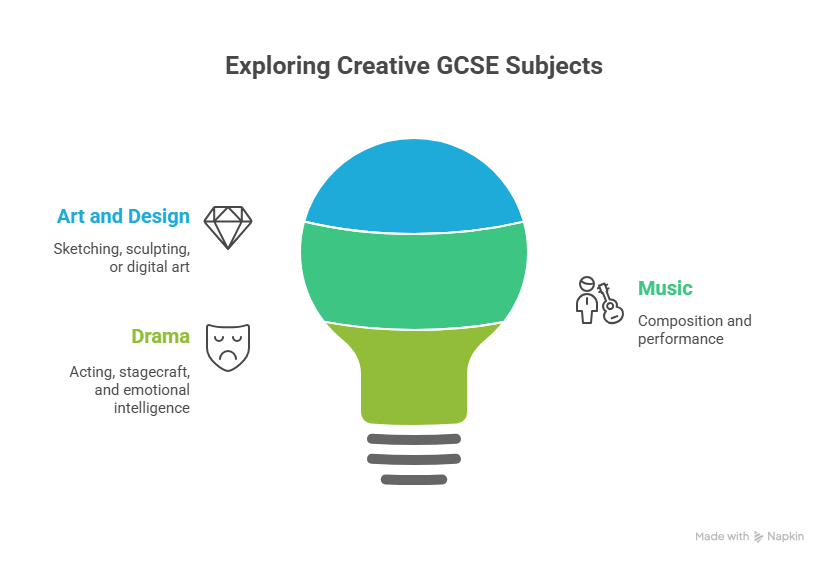
Art and Design: Sketching, sculpting, or digital art.
Music: Composition and performance (yes, you can bring your guitar!).
Drama: Acting, stagecraft, and emotional intelligence.
Creative GCSEs add variety to your profile, which helps when you apply to colleges later.
Technology & Innovation: Building Tomorrow
Why Tech Subjects Are Becoming Essential
The UK digital economy is growing rapidly
Coding is now a foundational skill
AI & cybersecurity careers are expanding
Employers value problem-solving skills
Subjects like Design and Technology (D&T) and Computer Science are perfect for problem-solvers.
In D&T, you’ll build prototypes and test ideas — blending creativity and engineering.
Meanwhile, Computer Science dives into coding, algorithms, and cybersecurity — a modern essential.
Want a head start? Check UK Safer Internet Centre for insights into responsible digital learning.
Physical Education (PE) and Health
PE isn’t just about running laps — it includes anatomy, physiology, and sports psychology.
If you love fitness or plan to go into physiotherapy, coaching, or sports science, GCSE PE is both practical and theoretical.
Religious Studies and Ethics
Religious Studies (RS) explores global faiths, morality, and ethical questions.
It’s less about religion itself and more about understanding perspectives, culture, and reasoning — useful in public service and diplomacy.
Optional GCSE Subjects: Building Your Identity
Once you’ve got your core subjects nailed down, you’ll choose electives. These might include:
Business Studies
Psychology
Sociology
Media Studies
Food Technology
Your optional subjects shape your story. A mix of creative and academic options shows balance and curiosity — two traits every college loves.
Choosing electives is where students often need the most GCSE options advice, especially when balancing creative and academic strengths.
GCSE Subject Requirements for Sixth Form
Most sixth forms require:
A minimum of 5 GCSEs at grade 4 or higher, including English and Maths.
For Science or Maths A-Levels, a grade 6+ in those subjects.
Every sixth form or college sets its own rules, so always check their site (like UCAS Further Education) before finalizing choices.
Choosing the Right 11 GCSE Subjects (Without Losing Sleep)
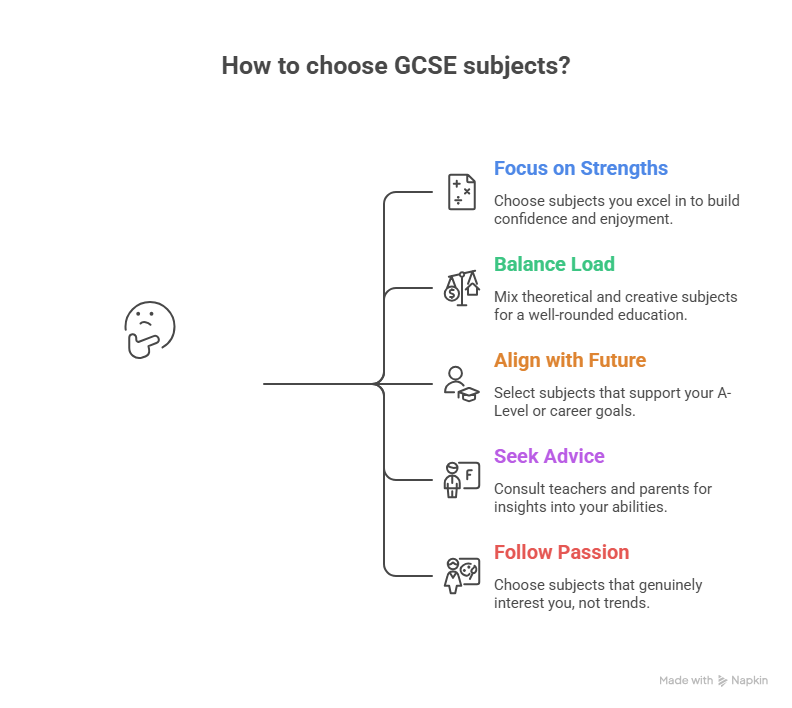
Here’s a proven 5-step approach:
Start with strengths. Love numbers? Take Computer Science or Economics.
Balance your load. Mix theory (like History) with creativity (like Art).
Think ahead. Align with your A-Level or career path.
Seek advice. Teachers and parents can spot your natural flair.
Don’t chase trends. Choose what excites you, not what your friends pick.
How GCSE Choices Influence Your Future
GCSE results are your first impression to colleges and universities. They show discipline, curiosity, and capability.
Even employers look at English and Maths grades as benchmarks for communication and reasoning.
Your choices today quietly shape your tomorrow.