Triple Science GCSE Revision Tips from a Top Student

This article isn’t a boring GCSE science revision guide — it’s a breakdown of what actually worked for me when I scored top marks in my GCSE Triple Science exams under the AQA specification. You’ll learn how to:
Build a GCSE revision plan that keeps you consistent.
Use active recall for science and past papers like a pro.
Turn tricky practicals and equations (yep, things like P = VI and E = mcΔT) into automatic responses.
Stay calm, confident, and focused when everyone else is freaking out.
Why Triple Science GCSE Is Hard & How to Revise Smart for Top Grades
Choosing Triple Science GCSE isn’t just taking on “more content.” It’s training your brain to think in layers: from cells to systems in Biology, particles to products in Chemistry, and forces to fields in Physics. If you’re eyeing A-levels in any science—or careers like medicine, engineering, or data science—Triple Science gives you a head start.
Your win condition isn’t working longer; it’s working smarter:
Pattern recognition: Past questions recycle setups (osmosis, rate experiments, IV curves).
Consistency: Short daily sessions beat weekend marathons.
Feedback loops: Every error is a free hint—capture it, fix it, retest it.
How to Revise Triple Science AQA/OCR/Edexcel Using the Specification
When I started revising for Triple Science GCSE, I made the same mistake most students do — I read my textbook from front to back and thought, “Okay, I’ve covered everything.” Spoiler: I hadn’t.
Your textbook is just the story, but your exam specification is the blueprint. The AQA Triple Science syllabus, OCR specification, and Edexcel Science exam board documents tell you exactly what you need to know — down to the phrasing of questions, command verbs, and how many marks a topic usually carries. It’s like being handed the marking scheme before the race even starts.
If you don’t know your spec, you’re revising blind. Trust me on that.
One thing Suited Tutor’s top GCSE Biology tutor always tells students is this: ‘The examiners don’t test your memory… they test how well you understand the specification.’ That reminder alone saved me hours of pointless revision.
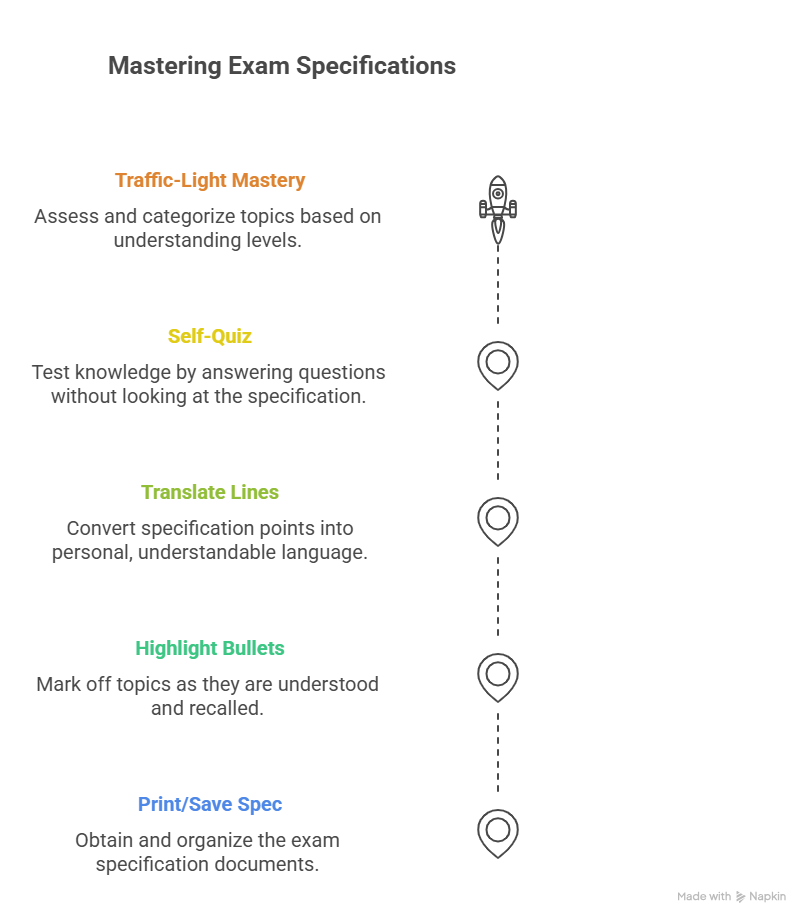
How to Turn the Spec into a Secret Weapon
Your book tells the story; your specification (AQA/OCR/Edexcel) is the blueprint. If it’s on the spec, it’s testable. If it isn’t, don’t sink time into it.
Turn the spec into a weapon:
Print/save each spec. Highlight bullets once you can recall them, not when you’ve merely read them.
Translate each line into your own words (e.g., “Osmosis = water moves from dilute to concentrated through a partially permeable membrane.”).
Self-quiz out loud with the spec covered.
Traffic-light your mastery (Green/Amber/Red) and plan study time accordingly.
Command Words Are Your Clues
Examiners hide hints inside the verbs. Here’s what they really mean:
(Source: BBC Bitesize – GCSE Command Words )
GCSE Triple Science Revision Plan (Biology, Chemistry, Physics)
Crisp, repeatable structure wins.
According to our award-winning Physics tutor at Suited Tutor, most students don’t fail Triple Science because it’s ‘hard’ — they fail because their revision plan is chaotic. A structured routine turns science into a rhythm, not a panic cycle.
Daily: 3×30 Method
30 min Biology → 30 min Chemistry → 30 min Physics
Each block: 25 min focused learning + 5 min recall dump (write everything you remember, then patch gaps).
Weekly Planner: Combine Past Papers + Active Recall
A perfect week for Triple Science GCSE looks something like this
(Adapted from AQA GCSE Science Study Support and BBC Bitesize Revision Planner)
The Three Questions That Keep Your Revision on Track
Every week, I’d ask myself three brutally honest questions:
What did I actually learn?
What’s still fuzzy?
What’s next week’s priority?
GCSE Science Active Recall Methods That Boost Biology, Chemistry & Physics
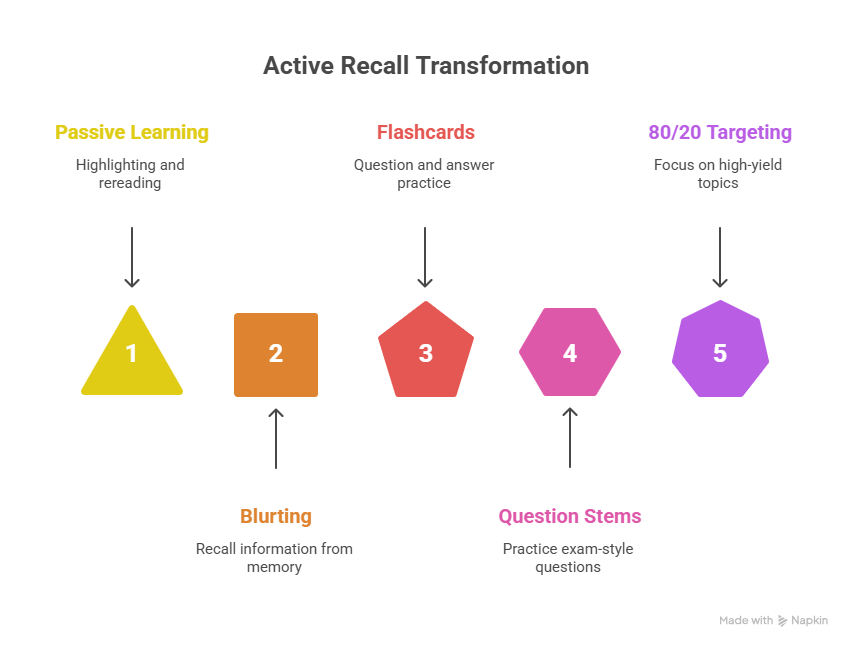
Dump the highlighter-fest. Active recall is the memory builder.
Blurting: Blank page → “Rate of reaction: what can I recall?” → patch in a different colour. Repeat next day for only the red bits.
Flashcards (properly): One question per card + tiny worked example on the back.
Question stems: Write your own “Explain/Compare/Evaluate” prompts to match mark-scheme language.
80/20 targeting: Identify the 20% of topics that yield 80% of marks (from past papers) and drill them relentlessly.
Suited Tutor’s Chemistry specialists always emphasise active recall over passive reading — they call it ‘the recall reflex.’ The more you train it, the faster you retrieve definitions, formulas, and steps under pressure.
Triple Science Past Papers Strategy for AQA, OCR & Edexcel
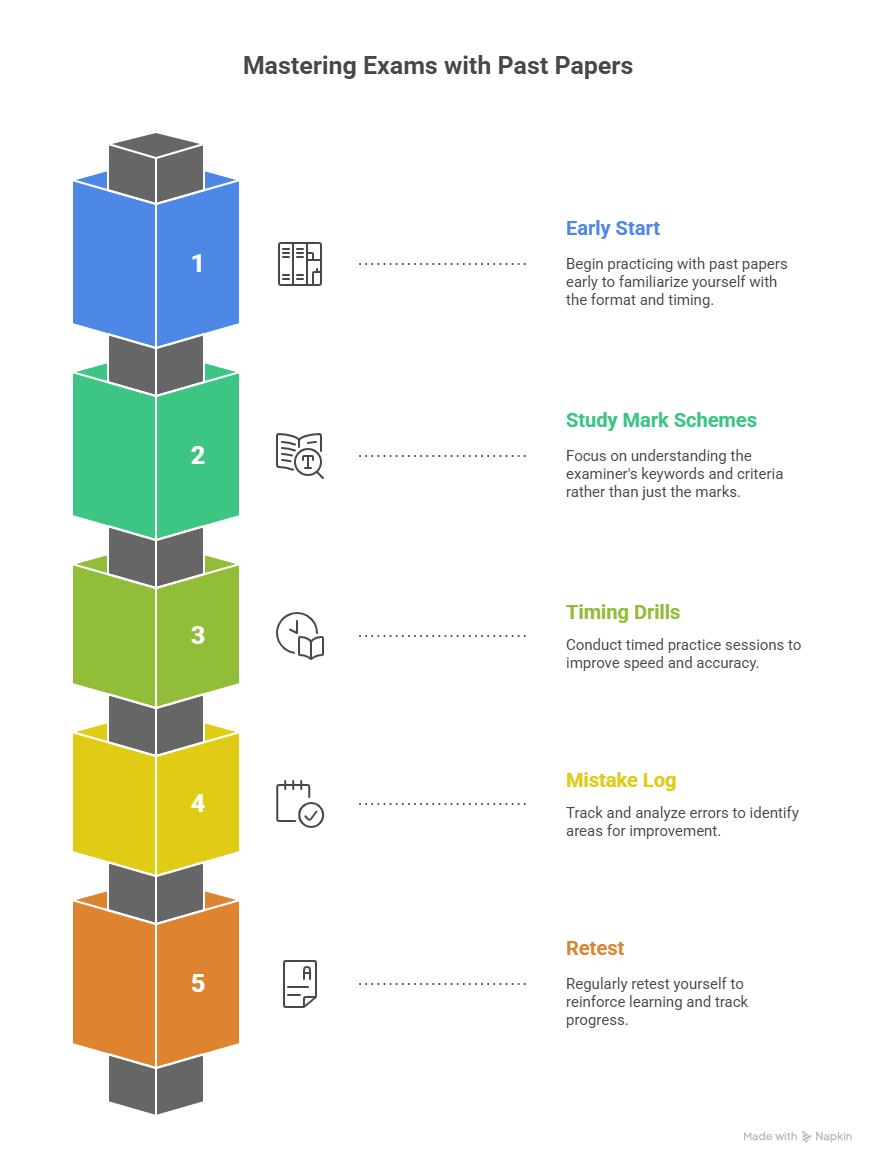
Past papers convert knowledge into exam instinct.
Start early, imperfectly. Learn format, timing, and phrasing.
Study mark schemes, not just marks. Copy examiner keywords (e.g., “proportional,” “linear,” “diffusion gradient”) into flashcards.
Timing drills:
10-mark sprint (10 min)
1-hour section sim (no pauses)
+10 min review (analyse errors)
Mistake Log: Topic → Cause (content/units/timing) → Fix (mnemonic/step/flashcard) → Retest date. Watching reds turn green is addictive—and effective.
One of Suited Tutor’s examiners-trained tutors once told me, ‘Past papers don’t prepare you for the exam — they prepare your brain for the examiner.’ Honestly, that advice changed how I approached every paper.
Maths Skills You Need for Triple Science GCSE Exams
You don’t need to be Einstein. You just need these essentials:
How to Master Graphs Like a Pro
If you ever see a question involving a line graph, you’re about to earn easy marks — if you know what to look for.
Here’s my rule:
Slope = rate or speed.
Intercept = starting point.
Straight line = proportional relationship.
Curved line = changing rate (e.g., enzymes or velocity).
When drawing lines, use a ruler — examiners literally award marks for it. And if they ask for a tangent, don’t panic. Pick a smooth point on the curve, draw a straight line that just touches it, and calculate the slope:
That’s it. No magic.
Equations You Must Know Cold
The hardest part of GCSE Physics revision is the sheer number of formulas — but they’re logical once you understand how they connect.
Here’s how I grouped them:
How to Tackle Required Practicals Without the Stress
If you’re like me, the phrase “GCSE required practicals” probably makes you groan a little. It sounds dull — measuring, recording, repeating. But here’s the truth no one tells you: these practicals are free marks just waiting to be claimed.
Examiners love them because they test understanding, not memorization. You won’t need to write the exact experiment step-by-step — you’ll need to explain why you did something, what variables you controlled, and how you’d improve accuracy.
Once you crack the pattern, you can walk into any paper — AQA, OCR, or Edexcel — already knowing what’s coming.
How to Tackle Practicals Without Panic
Here’s a formula that saved me (no pun intended):
👉 AIM → VARIABLES → METHOD → RISK → EVALUATION
Use it for every practical you revise. It’s simple, fast, and keeps your answers tidy.
Let’s break that down:
AIM: What are you testing? (e.g., “To investigate the effect of temperature on enzyme activity.”)
VARIABLES: Independent, dependent, control — always name them.
METHOD: Write in logical steps, use measurable quantities (volume, time, mass).
RISK: Mention something realistic — burns, glass breakage, chemical irritation.
EVALUATION: Suggest how to improve precision (repeat readings, same volume, control temperature).
It’s that easy. You’re not writing a lab report — you’re showing the examiner you get it.
⭐ Required Practicals Don’t Have to Be a Mark-Losing Nightmare
Most Triple Science students lose marks here — not because the experiments are hard, but because the exam phrasing catches them off guard.
At Suited Tutor, our specialists teach a predictable, easy-to-apply structure that secures these method marks every time.
Biology Practicals You Must Know
Biology practicals are about observation and analysis — not fancy equipment. Here are the heavy hitters:
Source: AQA GCSE Biology Required Practicals
Chemistry Practicals You Must Know
Chemistry practicals test your accuracy and ability to describe patterns.
Reference: Royal Society of Chemistry – Practical Chemistry
Physics Practicals You Must Know
Physics practicals are where equations meet experiments — and where most students panic. Don’t. Once you understand the flow, it’s all logic.
Reference: OCR GCSE Physics Practicals
Top-Scoring Biology Tips You Can Actually Use
Genetics quick-view: Genotype (letters), phenotype (trait), allele (version), homo/heterozygous. Use Punnett squares with ratios and probabilities.
Ecology fast wins: Carbon/Nitrogen cycles, trophic levels, biomass pyramids; mention energy loss through heat/waste and matter recycling.
The ladder: Cells → tissues → organs → systems. Always connect structure to function.
Memory hooks: MRS GREN, “MITOSIS = MULTIPLY,” “MEIOSIS = MIX,” and the classic OIL RIG for redox language appearing in respiration items.
Essential Chemistry Revision Hacks for Top Grades
Balancing without tears: Balance atoms first, charges last; treat repeating polyatomic ions (e.g., SO₄) as units.
Moles/titrations (5-step): Balanced equation → convert cm³→dm³ → n = c × V → use ratios → check units/sig figs.
Electrolysis in one breath: Opposites attract; write half-equations; identify gases correctly.
Thermochemistry: Endothermic = absorbs heat (temp down); exothermic = releases heat (temp up). Sketch quick energy profiles.
Essential Physics Revision Tricks for Higher Marks
Formula fluency: Group by theme (Energy/Motion/Electricity/Waves). Drill with substitution, not just reading.
Triangle method for rearranging: e.g., speed = distance/time: cover what you need and read off the relationship.
Circuits intuition:
Series: current same; voltages add; resistances add.
Parallel: voltage same; currents add; resistance drops.
Graphs: Axes + units, ruler lines, gradient = rate, area under v-t graph = distance. Curve = changing rate.
Memory Techniques You’ll Actually Use
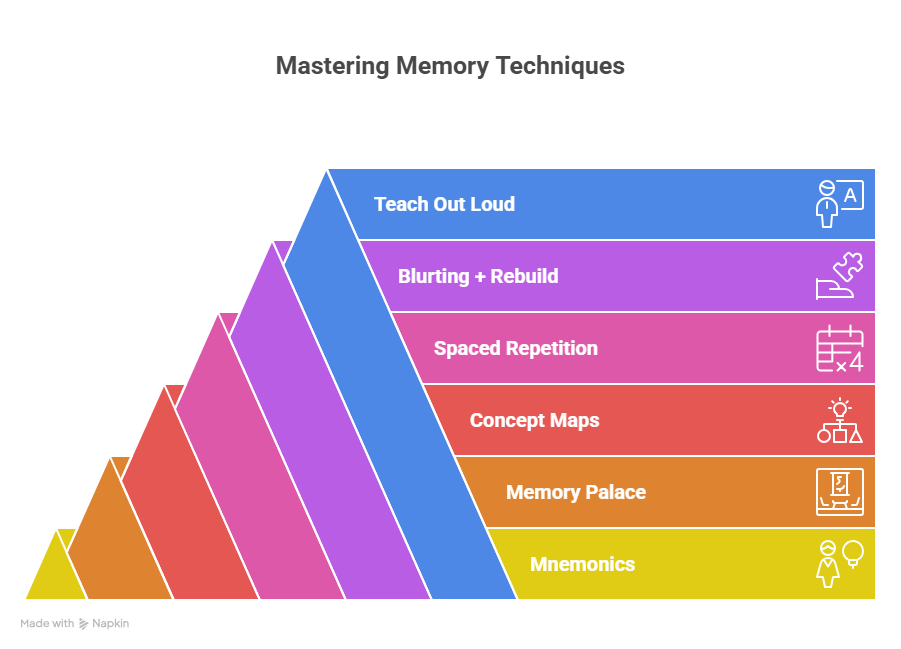
Make your own mnemonics: The weirder the better (you’ll remember them).
Memory palace: Place topics around a familiar room/route; “walk” it before mocks.
Concept maps: Put “Energy” or “Bonding” in the center; branch to formulas/examples.
Spaced repetition cadence: 1-day → 3-day → 7-day → 14-day reviews.
Blurting + rebuild: Dump from memory, then patch in a new colour; repeat till clean.
Teach it out loud: If you can explain it simply, you own it.
A simple weekly memory loop:
Mon: 1 blurted topic (20 min)
Tue: Flashcards + spaced review (25 min)
Wed: Teach a concept (15 min)
Thu: Concept map refresh (30 min)
Fri: 10-min memory palace walk-through
The Ultimate Exam Strategy Guide for Triple Science GCSE
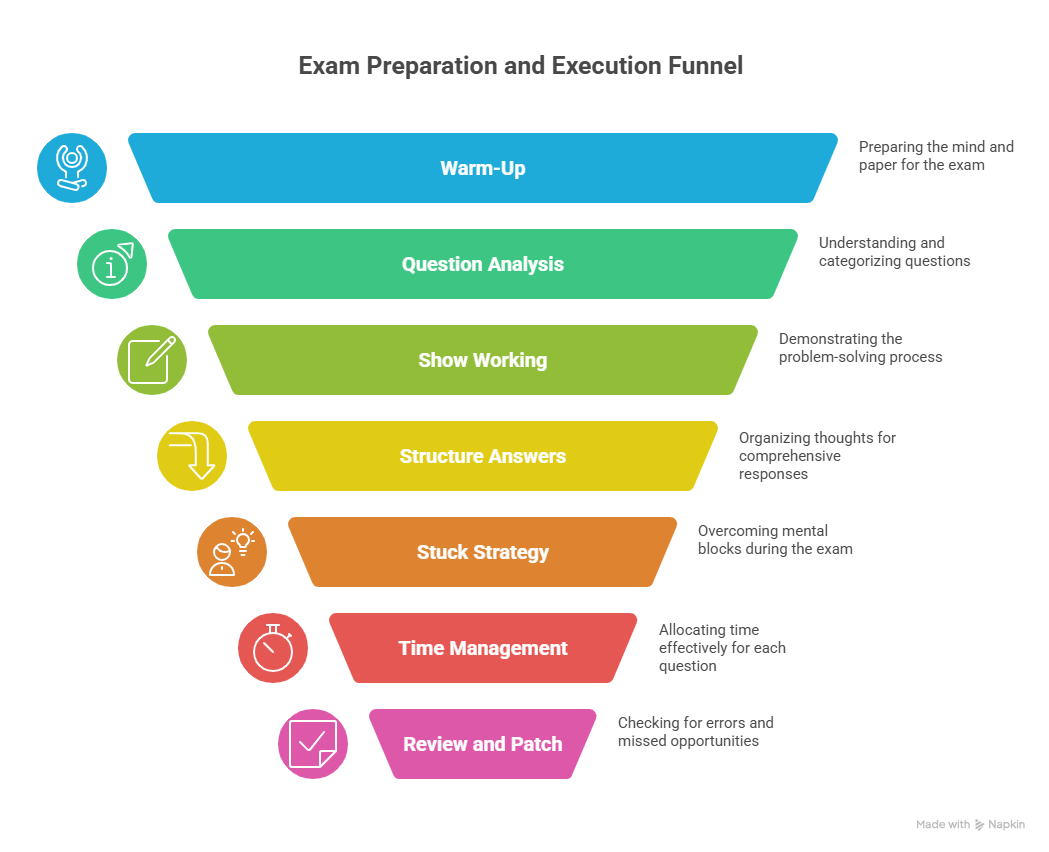
Here’s the playbook that saved me — and can save you too.
Step 1: Warm Up Like an Athlete
Before the invigilator even says “begin,” take a moment to steady your mind. Don’t jump straight into writing — that’s like sprinting without stretching.
Skim the entire paper (30–60 seconds).
Circle the easy wins — short recall questions you can do first.
Mark longer 6-mark questions with a star (you’ll return to them).
That 60-second scan sets your rhythm. You’ll start fast, build confidence, and reduce early anxiety.
Step 2: Read the Question, Not What You Think It Says
You’d be surprised how many students lose marks not because they’re wrong — but because they answered a different question.
If it says “Describe,” don’t explain.
If it says “Evaluate,” don’t just list pros and cons — make a judgment.
Here’s a quick command-word decoder
Step 3: Show Working — Always
If you’re doing Physics or Chemistry, never just write the answer.
Even if you’re guessing, show how you got there:
Write the formula first.
Substitute the values.
Include units.
You can score method marks even when your final number is wrong. I once got 2/3 marks just for writing E = mcΔT correctly — even though my calculation was way off. That’s the difference between a grade 6 and a grade 8.
Step 4: Tackle the 6-Mark Questions Like a Story
Big-mark questions scare everyone. The trick is structure.
I used PEEL — Point, Evidence, Explain, Link.
Example:
Question: “Explain how the heart and lungs work together during exercise.”
Answer:
P: The heart rate increases to pump blood faster.
E: This delivers more oxygen to muscles.
E: The lungs work harder to remove carbon dioxide and bring in more oxygen.
L: Together, they maintain aerobic respiration so energy can be released efficiently.
That’s it. Logical, structured, full marks.
Step 5: The “Stuck” Strategy
We all hit that blank moment. Don’t panic. Here’s what I did every time it happened:
Underline the data — numbers, units, keywords.
Write down any formula that might fit.
Make an educated guess — use context clues.
Move on after 90 seconds.
Sometimes, your brain just needs to reset. When you come back, it’ll click.
Step 6: Timing = Marks
Each paper gives you roughly a minute per mark. So for a 6-mark question, aim for six minutes max.
Here’s how to train it:
Practise 10-mark sprints at home — answer 10 marks in 10 minutes.
Use a timer.
Always leave 5 minutes at the end for unit checks and missed blanks.
Step 7: Review and Patch
When you finish, don’t close your paper right away. Do a mark-hunt.
Check equations for missing units.
Revisit “explain” questions and see if you gave a reason.
Skim for unattempted parts — even one keyword can earn half a mark.
Common GCSE Science Mistakes and How to Fix Them Fast
Missing units: Write them with the number. Put a tiny “U?” in your margin as a reminder.
Early rounding: Carry full precision; round once at the end to the least precise data.
Answering around the question: Mirror the command word in your opening line.
Definition drift (Chem): Ionic = transfer, covalent = sharing, mass conserved. Keep a contrast table.
Forgetting control variables: In practicals, list IV/DV/controls as a rhythm.
No working shown: Layout earns method marks even when answers wobble.
No review habit: Maintain a Mistake Log. Re-attempt similar items 48–72 hours later.
Panic blanks: Write something—a formula, a labelled diagram, or a definition. Partial credit stacks up.
Final Month Game Plan
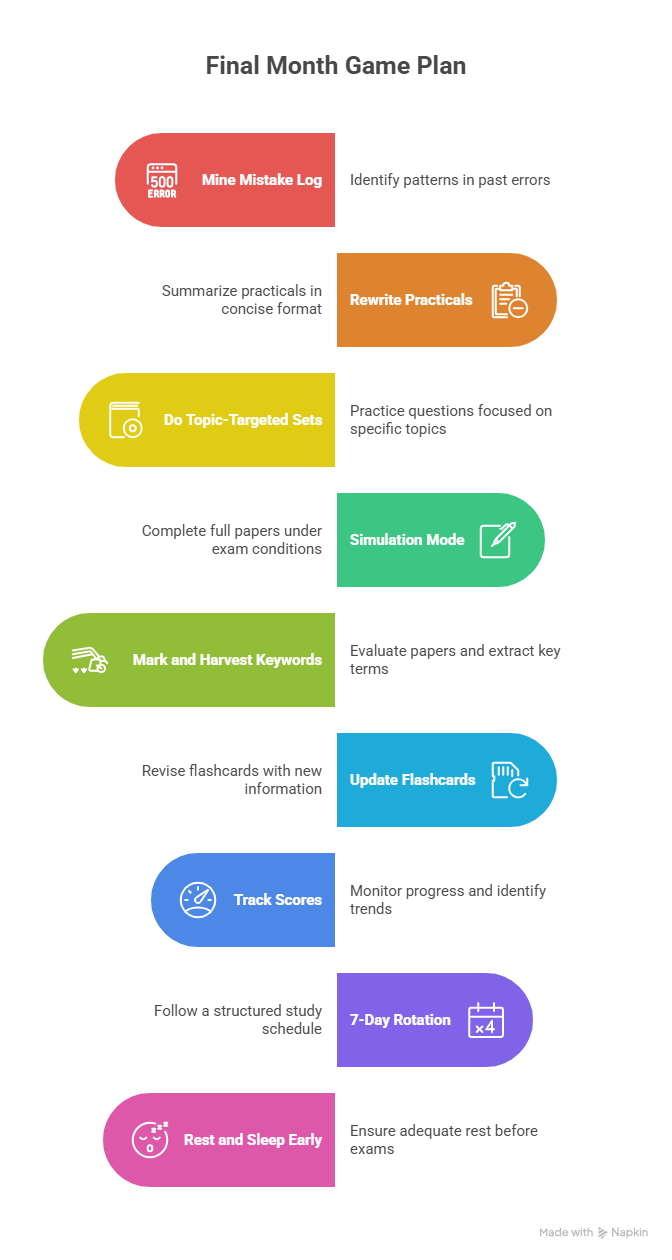
Weeks 1–2: Fix foundations
Mine your Mistake Log for patterns (units, timing, specific topics).
Re-write required practicals in 6 lines each (Aim → Variables → Method → Risk → Evaluation → Improvement).
Do topic-targeted sets from past papers; blurt summaries after each.
Week 3: Simulation mode
One full paper every two days (rotate B/C/P).
Mark with official schemes; harvest keywords; update flashcards.
Track scores to spot trend lines and celebrate jumps.
Week 4: Sharpen, don’t cram
7-Day rotation:
Day 1 Bio (defs + short Qs)
Day 2 Chem (equations + practicals)
Day 3 Phys (equations + graphs)
Day 4 Mixed 60-min mini-mock
Day 5 Mark & patch
Day 6 Light review + flashcards
Day 7 Rest, sleep early
Final 48 hours: Review summaries, equations, and practicals only. No new topics. Sleep properly.
Exam day: Eat something light, breathe 4-in/6-out, start with easy wins, leave 5 min for a unit/blank sweep.
Ready to Turn All These Strategies Into Actual Exam Results?
If you want personalised feedback, structured revision plans, and weekly accountability, Suited Tutor pairs you with expert Triple Science tutors who specialise in AQA, OCR, and Edexcel success.
No pressure — just focused guidance that helps you move from “I’m trying” to “I’m improving.”