How to Pass GCSE Maths: The Complete, No-Stress Study Blueprint

Know the Exam You’re Sitting
Before stressing about formulas or past papers, you need to actually understand the battlefield you’re walking into. GCSE Maths isn’t just one universal exam; it varies depending on the exam board, the tier you’re entered for, and the assessment objectives that markers use to award grades. Grasping these details early on will shape your entire revision plan and make passing feel less like a gamble and more like a strategy.
Boards & Specs: AQA vs Edexcel vs OCR
In England, the three giants of GCSE Maths are AQA, Edexcel, and OCR. Each board sets papers with slightly different styles:
Your school decides the board, so download the specification straight from their website:
This specification is your rulebook—it literally lists every single topic you could be tested on. Treat it like your revision checklist.
Foundation vs Higher: Which Tier Fits You?
One of the first big decisions is whether you’ll sit the Foundation Tier (Grades 1–5) or the Higher Tier (Grades 4–9). Here’s the quick breakdown:
Assessment Objectives (AO1/AO2/AO3) Explained
Every single mark in your paper comes from one of three Assessment Objectives (AOs):
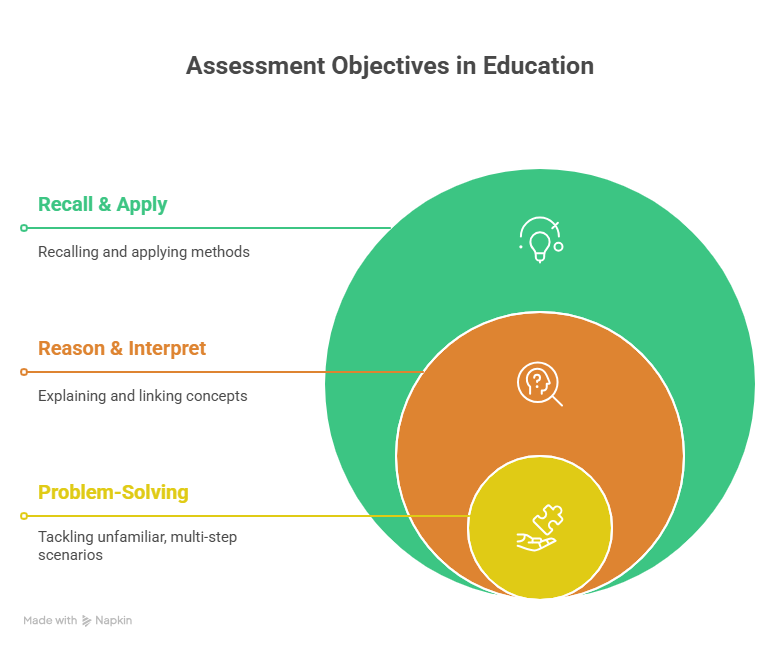
AO1: Recall & Apply (≈50%)
Using methods, formulae, and calculations.
Example: Solve 2x+3=112x + 3 = 112x+3=11.
AO2: Reason & Interpret (≈25%)
Explaining, linking concepts, interpreting graphs or diagrams.
Example: “Explain why triangle ABC is isosceles.”
AO3: Problem-Solving (≈25%)
Tackling unfamiliar, multi-step scenarios.
Example: “A farmer wants to fence a field… how much wire does he need?”
Set a Target Grade and Build a Plan
One of the most overlooked steps in learning how to pass GCSE Maths is simply knowing what grade you’re aiming for. Without a clear target, your revision ends up scattered and reactive. But with a target grade and a structured plan, every practice paper, every formula memorised, and every late-night calculation suddenly has direction.
SMART Goals that Actually Stick
It’s easy to say “I want to pass GCSE Maths,” but what does that look like in practice? That’s where SMART goals come in:
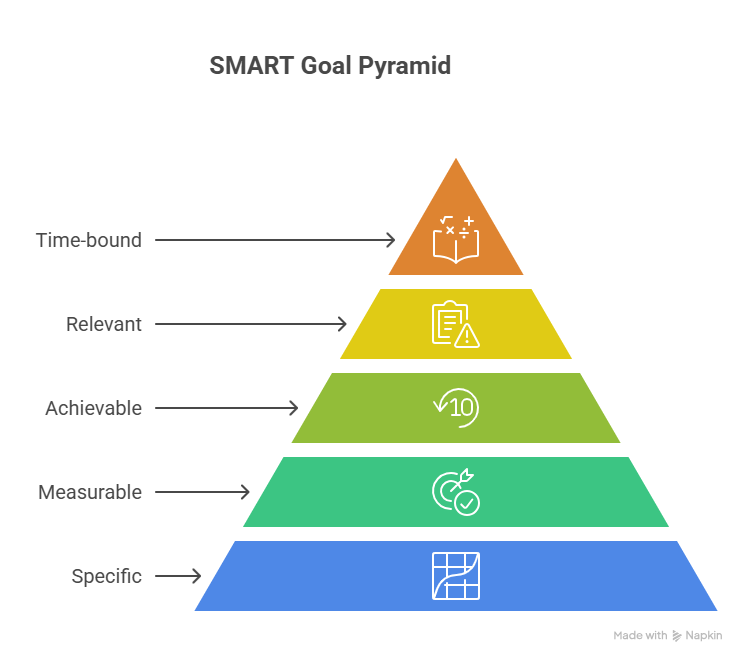
Specific: “I’ll revise quadratic equations using past papers.”
Measurable: “I’ll get at least 75% correct in a topic test.”
Achievable: Don’t aim for Grade 9 if you’re sitting on a shaky Grade 3—climb steadily.
Relevant: Focus on exam-board topics, not random maths trivia.
Time-bound: Set deadlines, e.g., “I’ll master simultaneous equations by next Friday.”
A realistic SMART goal example:
“By the end of this week, I’ll complete 20 GCSE Maths algebra practice questions and score at least 16/20.”
This way, your revision feels like ticking off boxes instead of wandering around in the dark.
Backward Planning from Exam Day
Start with the finish line: your exam date. Work backwards week by week, slotting in topics and past papers. This is called backward planning, and it ensures you don’t panic-cram everything in the final fortnight.
Think of it like training for a marathon: you wouldn’t just run 26 miles on race day without months of structured runs leading up to it. Similarly, your GCSE Maths revision plan should mix core topics, exam technique, and timed practice.
Sample 12-Week Study Map
Here’s a rough 12-week roadmap you can adapt. Swap topics around depending on your strengths and weaknesses:
Master the Core Topics First
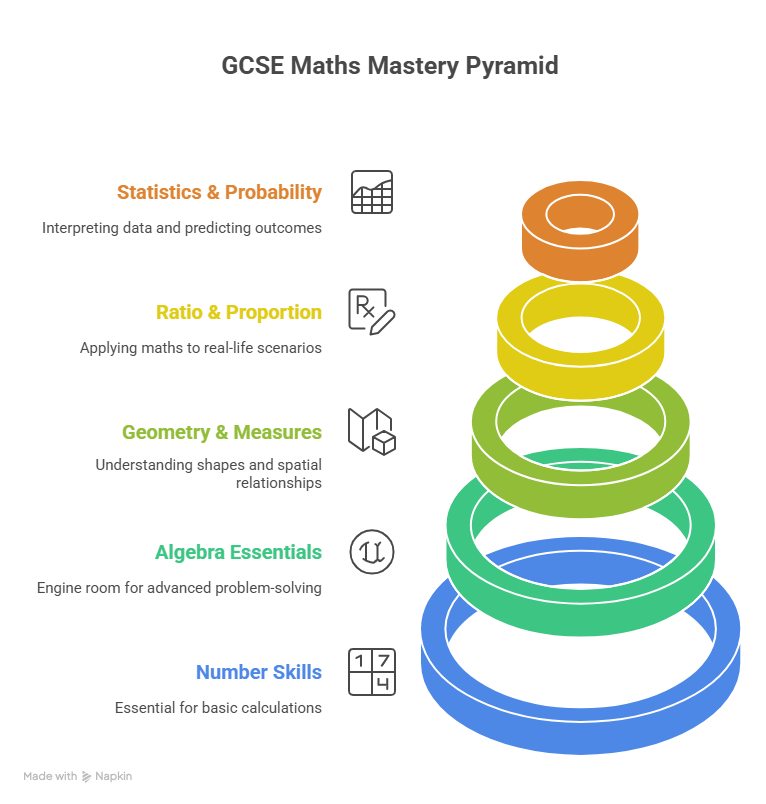
The best way to pass GCSE Maths isn’t by cramming the most advanced formulas—it’s by securing marks on the topics that come up again and again. Think of these as your “bread and butter” marks. Once you’ve locked them down, the trickier Higher content becomes less intimidating.
Number Skills You’ll Use Everywhere
Numbers never disappear in this exam. Even complex questions often boil down to percentages, ratios, or fractions.
Key must-haves:
Converting fractions ↔ decimals ↔ percentages quickly.
Multiplying/dividing negatives without hesitation.
Estimation tricks: round numbers sensibly to check if your answer looks realistic.
Example: If a recipe needs 250g of flour and you only have 2kg, estimate how many cakes you can make without touching a calculator.
Algebra Essentials (The Grade-Booster)
Algebra is the engine room of GCSE Maths. Weak here? You’ll struggle across multiple papers. Strong here? You unlock grades 6–9.
Simplify, expand, and factorise expressions.
Solve linear equations (including brackets and fractions).
Tackle quadratics: factorising, completing the square, quadratic formula.
Rearrange formulas (common in physics-style cross-over questions).
Pro tip: Work with past papers. Spot algebra creeping into “real life” worded problems—it’s a sneaky but common way examiners test reasoning.
Geometry & Measures Without the Panic
Geometry can feel like alphabet soup—Pythagoras, trigonometry, circle theorems. Break it down:
Angles in triangles, parallel lines, and polygons.
Areas: circles, trapezia, compound shapes.
Volumes: cylinders, prisms, pyramids.
Trigonometry (SOH-CAH-TOA): first for right-angled triangles, then extended in Higher.
🎯 Remember: geometry questions often reward method marks, so even half a correct diagram with some labelled angles can score you points.
Ratio, Proportion & Rates of Change
This is where real-life maths meets the exam.
Direct and inverse proportion (tables, graphs, equations).
Compound measures: speed, density, pressure.
Best-buy problems—classic for Foundation.
Growth and decay—essential for Higher.
Statistics & Probability Made Friendly
Data doesn’t need to scare you. Most marks come from interpreting, not hardcore calculation.
Mean, median, mode, range.
Reading bar charts, histograms, box plots.
Probability trees and Venn diagrams.
Tip: Always write probabilities as fractions or decimals, and check they add up to 1. A silly slip here can cost marks.
Need personalised guidance? Book a 1:1 GCSE Maths tutoring session with Suited Tutor and get tailored exam strategies.
Calculator vs Non-Calculator: Two Different Games
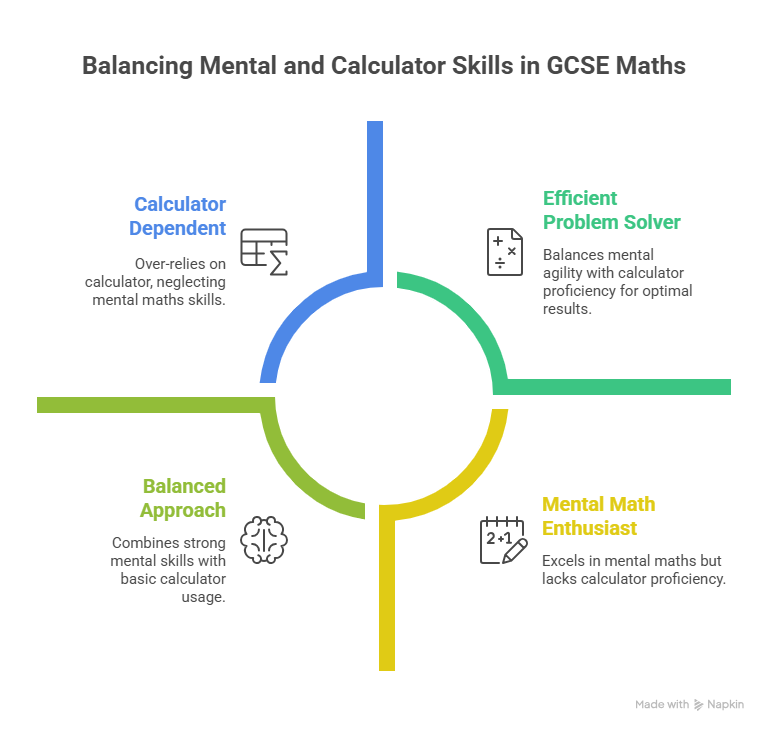
Solving tricky problems is like treating the calculator and non-calculator papers the same way. They’re completely different beasts. The non-calc paper tests your mental sharpness and ability to show working clearly. The calculator paper, on the other hand, tests whether you can use technology wisely without leaning on it too heavily.
A seasoned Math tutor will tell you this: the calculator is a tool, not a crutch. You still need to understand the steps, because method marks can save you when the final answer goes astray.
Mental Methods that Save Marks
On the non-calculator paper, the difference between scraping a pass and walking out confident often comes down to your number fluency.
Essential mental strategies:
Break percentages down: 10%, 5%, 1% chunks.
Square numbers up to 15 in your head—these show up often.
Approximate roots: know that √50 is about 7.1, not 12 or 3.
Cancel fractions quickly (24/36 → 2/3).
💡 Practice a 5-minute mental maths warm-up daily—fractions, quick squares, ratios. It builds agility like stretching before sport.
Calculator Tricks You’re Allowed to Use
The calculator paper rewards smart button-pushing and sharp reasoning. But many students lose marks by either over-relying on the machine or under-using its features.
Here’s what to master:
Use brackets—never trust memory when dealing with BIDMAS.
Use the ANS key for chained calculations.
Store values in memory for multi-part questions.
Always check your calculator is in DEG mode for trigonometry.
Practise recurring decimals, standard form, and complex fractions.
A Math tutor will often set students “calculator drills” where you re-do the same question twice: once by hand, once on the calculator, then compare. This hybrid approach cements understanding.
High-Yield Topics (Score Fast, Score Smart)
Some topics pop up on nearly every exam. They’re the low-hanging fruit—questions you can bank marks on without being a genius. Focus on these, and you’ll secure a safety net before wrestling with trickier Higher material.
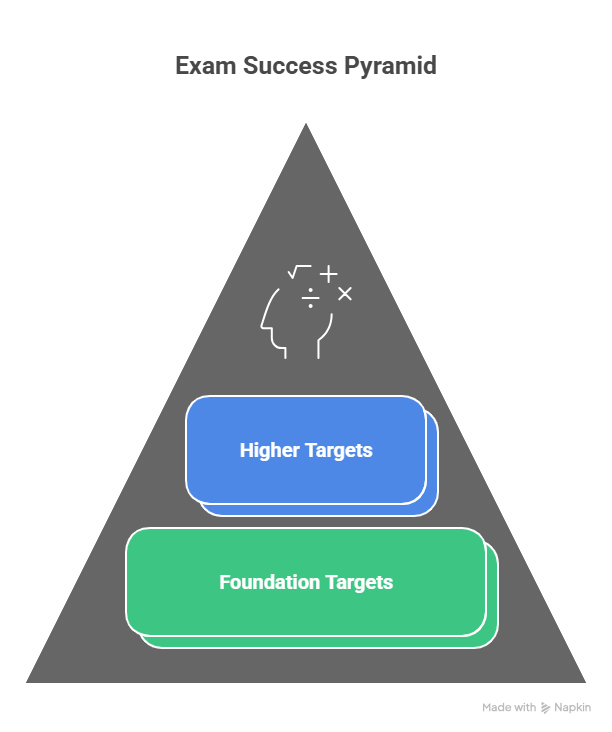
Top Foundation Targets
If you’re sitting Foundation, these areas are non-negotiable:
Fractions, decimals, percentages.
Ratio and proportion word problems.
Area and perimeter of 2D shapes.
Volume of prisms.
Simple linear equations.
Reading graphs and basic averages.
🎯 Students who drill these can often jump from a shaky Grade 3 to a secure Grade 5—the threshold for passing.
Top Higher Targets
For Higher candidates, target these first:
Quadratics: factorising, solving, graphing.
Simultaneous equations (elimination + substitution).
Indices and surds.
Sine and cosine rule (non-right-angled trig).
Circle theorems.
Probability distributions, cumulative frequency, histograms.
These topics are almost guaranteed to appear. Even partial working can net you vital marks.
Exam Technique: Where Many Marks Are Won
You can know the content inside out, but without good exam technique, you’ll leak marks. Think of exam technique as your game-day strategy. It’s not about what you know—it’s about how you use it under pressure.
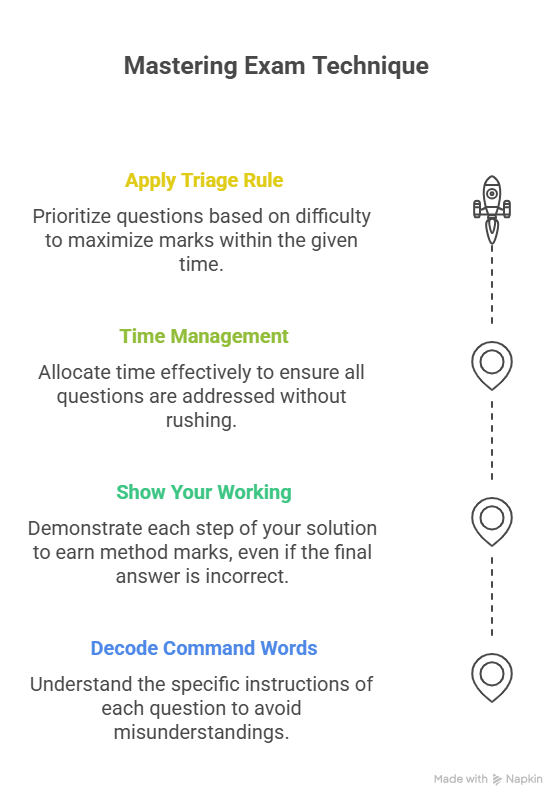
Decode Command Words
Pay attention to the words examiners use. They’re not random.
“Show that” → write down every step, don’t skip.
“Estimate” → round numbers first, then calculate.
“Prove” → provide logical steps, not just an answer.
“Hence” → use your earlier result; don’t start over.
A good Math tutor will hammer this point: sometimes students know the maths but misunderstand the command word, costing them full marks.
Method Marks: Show Your Working Like a Pro
Even if you’re unsure, always show what you tried. Examiners often award marks for setting up the right formula, even if you make a calculation slip.
Examples:
That single line can be the difference between a U and a pass.
Time Management That Doesn’t Melt Your Brain
Timing is a nightmare for many students. The trick is to triage your questions.
Start with quick wins—bank confidence.
Move to medium-level questions—steady marks.
Save the trickiest ones for the end.
Never let a single 5-mark problem drain 15 minutes. That’s self-sabotage.
The 10-50-40 Triage Rule
First 10% of time → blitz through all the easy marks.
Next 50% → tackle medium-level questions.
Final 40% → go back to the beasts and polish working.
Real Problem-Solving (AO2/AO3)
Passing GCSE Maths isn’t just about crunching numbers—it’s about reasoning and problem-solving, which make up around half the exam.
Model, Reason, Check Units
When a question throws you a real-world context (fencing gardens, buying paint, mobile tariffs), don’t panic.
Identify the variables.
Write equations or draw diagrams.
Label units clearly.
Always ask: “Does my answer make sense?” If you calculate that a school trip costs £12 million, something’s wrong.
Classic Traps and How to Dodge Them
Examiners love setting traps:
Mixing radius and diameter in circle questions.
Forgetting to square-root in Pythagoras.
Rounding too early.
Skipping unit conversions (cm to m, hours to minutes).
✅ At this stage, we’ve expanded through:
Calculator vs Non-Calculator
High-Yield Topics
Exam Technique
Real Problem-Solving
Revision Methods That Actually Work
Revision isn’t about sitting at your desk for three hours staring at notes—it’s about training your brain the right way. The biggest difference between students who scrape a pass and those who stride out of the exam hall smiling isn’t intelligence; it’s how they revise.
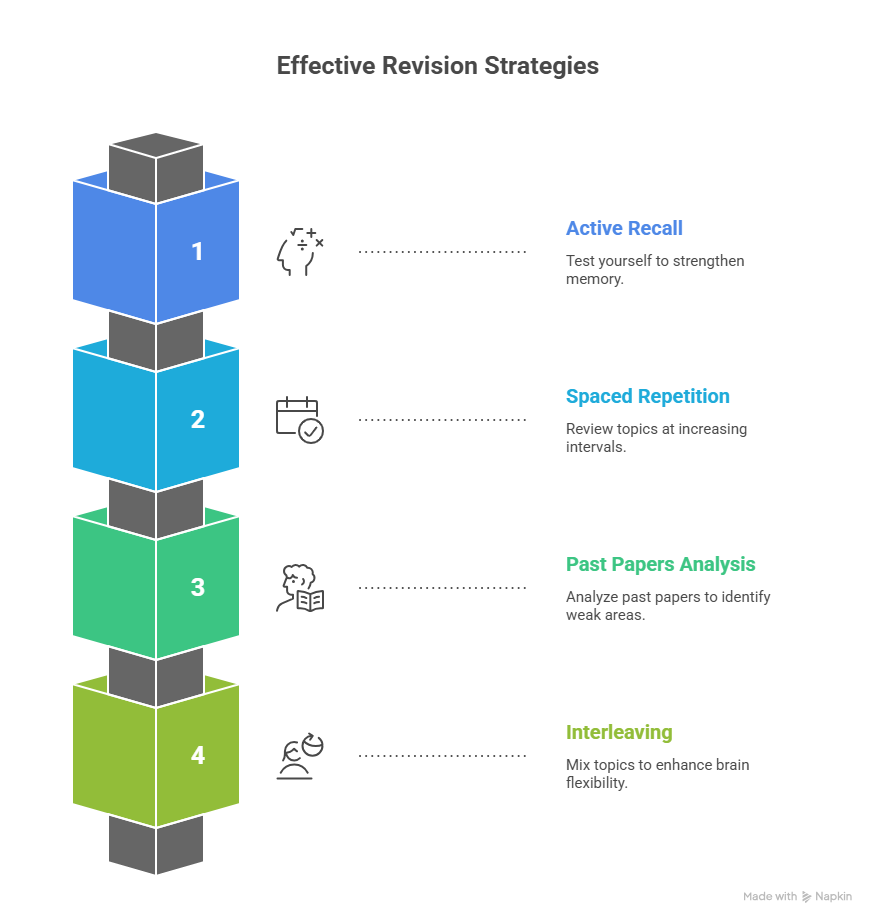
Active Recall + Spaced Repetition
Instead of re-reading your notes (which feels safe but does nothing), test yourself. That’s active recall.
Write a formula, cover it, recall it from memory.
Do five quick-fire questions, check answers, repeat the weak ones tomorrow.
Combine it with spaced repetition: revisit the same topics after 1 day, 3 days, a week, two weeks. Apps like Anki or Quizlet make this simple.
Past Papers + Question-Level Analysis (QLA)
Past papers are your rehearsal before the real show. But don’t just churn through them—analyse them.
Sit the paper under timed conditions.
Mark it honestly using the mark scheme.
Build a Question-Level Analysis (QLA) grid: topics down the side, your scores across.
This tells you exactly which topics bleed marks. Maybe you always lose points on probability trees or standard form. That’s your revision priority.
Interleaving: Mix It, Don’t Cram It
Cramming one topic for hours feels good in the moment—but your brain forgets fast. Instead, mix topics in a session.
Example 1-hour session:
20 minutes algebra questions.
20 minutes geometry (Pythagoras + trig).
20 minutes statistics and averages.
This “interleaving” makes your brain flexible. On exam day, you’ll be ready for the constant switching between number, algebra, and geometry.
Tools & Resources
You don’t need fancy gadgets, but the right tools and apps can make revision smoother and less stressful.
Websites & Apps Worth Your Time
Some reliable, free, and exam-board aligned resources:
BBC Bitesize → clear explanations and quick quizzes.
Corbettmaths → video tutorials and exam-style questions by topic.
Maths Genie → past papers, model solutions, and grade-specific worksheets.
Revision apps like Quizlet or Anki → perfect for formula memorisation.
The Right Calculator Setup
Your calculator is as important as your pen. For most boards, the Casio fx-83GTX or fx-85GTX is the go-to. Learn:
The fraction button (saves messy handwriting).
The recurring decimal key.
How to switch between standard form and normal notation.
Using memory to store values across multi-step questions.
Practise with the calculator you’ll take into the exam—don’t borrow a friend’s on the day.
Formulae & Memory Hacks
The formula sheet is helpful, but not everything is given. You need to know which formulas to memorise cold, and which will be provided.
What You Must Memorise vs What’s Given
Given: area of a circle, surface area of a cone, volume of a sphere.
Not given: trigonometric ratios (SOH-CAH-TOA), quadratic formula, circle theorems.
Print the official formula sheet for your board (AQA, Edexcel, OCR) and highlight what you need to memorise.
Cheat-Sheets, Mnemonics & Flashcards
Memory tricks work wonders:
SOH-CAH-TOA → for trigonometry.
Silly Old Harry… → mnemonic for trig ratios.
Flashcards → formula on one side, practice problem on the back.
Sticky notes → scatter formulas around your room.
Presentation & Accuracy
You could know all the formulas in the world, but if you mess up on units, rounding, or significant figures, you’ll drop marks you should’ve secured. Examiners love precision.
Always write units: cm, m², £, etc. Leaving them out can lose marks.
Unless told otherwise, give answers to 3 significant figures.
Don’t round mid-calculation—carry the exact value until the final step.
A small example: calculating speed. If the question asks for km/h and you leave the answer in m/s, you could throw away 2–3 marks for nothing.
Mock Exams: Practice Like It’s Real
Mocks aren’t just practice—they’re a dress rehearsal. Take them seriously, because they reveal everything: your weak topics, your time management, even how you handle exam nerves.
Review System: Error Log → Upgrade
Don’t shove your marked mock under the bed. Use it as a weapon.
Error log: Write down every mistake in a notebook.
Classify it: Was it a careless slip, a method you didn’t know, or a concept you misunderstood?
Upgrade it: Re-learn, re-practise, and re-test.
Over time, this log becomes your personalised GCSE Maths revision guide.
Exam-Day Game Plan
The night before the exam isn’t the time to panic-cram formulas. Instead, treat yourself like an athlete before a big match: eat right, rest well, and control your nerves.
Sleep, Food, Hydration, and Your Kit
Pack your kit: black pens, pencils, ruler, protractor, compass, and calculator.
Eat steady energy foods: oats, bananas, yoghurt. Avoid sugar highs.
Hydrate well, but don’t overdo it—no one wants a toilet break panic.
A calm morning routine can set the tone for the whole paper.
Anxiety-Control Routines
Even top students feel the nerves. A few quick strategies:
Box breathing: inhale for 4, hold for 4, exhale for 6.
Anchor phrase: whisper something like “I’ve got this” before starting.
Momentum trick: answer the easiest 3 questions first to build confidence.
If You’re Resitting or Need Adjustments
Resits are common, and there’s no shame in them. Many students actually perform better second time around because they know the exam style.
Extra time: If you have approved adjustments, practise with them so it feels normal.
Resit strategy: Focus on weak areas from your previous QLA instead of re-doing everything from scratch.
The key is not to repeat the same mistakes—use the feedback as a roadmap.
Parents & Guardians: How to Help
Parents often want to help but don’t know how. Hovering isn’t the answer—structured support is.
Create a quiet, distraction-free study environment.
Encourage healthy habits: sleep, meals, and downtime.
Celebrate effort, not just scores. Ask: “What did you learn today?” instead of “How many marks did you get?”
Supportive parents can be the secret weapon behind a student’s GCSE Maths success.
Final 7-Day Sprint Plan
Want guaranteed progress? Suited Tutor’s GCSE Maths specialists have helped hundreds of students jump 1–3 grades.