A Complete Guide to the GCSE Further Mathematics Syllabus: What Students Need to Know

If GCSE Further Maths feels like climbing a steeper hill, that’s because it is — but the view from the top is worth it. This advanced qualification takes you beyond standard GCSE Mathematics into the world of algebraic proofs, calculus, matrices, and mathematical reasoning.
Think of it as a bridge between GCSE and A-Level Maths, built for students who enjoy solving problems that make others pause. Whether you’re planning a future in engineering, physics, or data science, mastering Further Maths sharpens your logic and boosts your confidence. In this complete guide, we’ll unpack what’s inside the syllabus, how it differs from regular Maths, and why tackling it now can give you a powerful head start later on.
If you’re aiming for top grades or want a head start on A-Level Maths, Suited Tutor’s expert GCSE Further Maths tutors can help you master each topic with clarity and confidence.
How Further Maths Fits Alongside GCSE Mathematics
If GCSE Maths feels like a good jog through the park, Further Maths is that uphill sprint that builds real muscle. It doesn’t replace GCSE Maths — it expands it. You’ll explore deeper algebra, step into calculus, and meet new concepts like matrices and proof by contradiction.
According to the AQA specification, this qualification bridges the gap between GCSE and A-Level, giving students a head start on topics that later appear in university-level problem-solving.
Who Should Take Further Maths?
Students comfortably scoring Grade 7 or above in GCSE Maths.
Learners who enjoy reasoning and abstract problems.
Anyone eyeing A-Level Maths, Physics, or Computer Science.
💡 Pro tip: Think of it as your secret advantage—you’re learning the A-Level alphabet before the course even starts.
Exam Boards & Variations
Each exam board tweaks the recipe slightly. AQA, Edexcel, and OCR all offer versions of the qualification.
While AQA Level 2 Further Maths is most common, the core ingredients overlap:
algebra, trigonometry, matrices, functions, calculus, vectors, and proof.
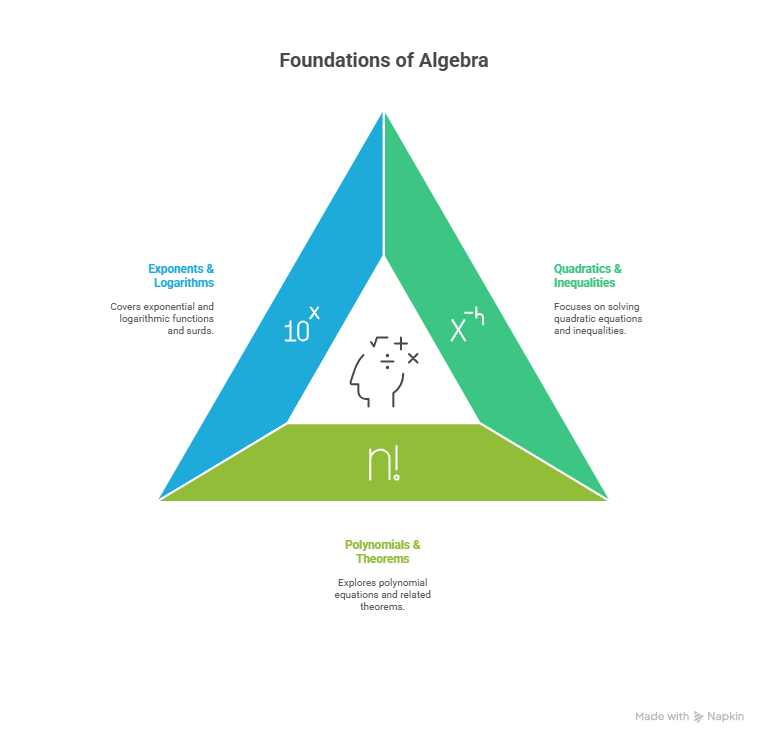
Core Algebra – The Heartbeat of Further Maths
Algebra is where logic meets creativity.
Here, you’ll stretch familiar GCSE tools to new limits — factorising fourth-degree equations, untangling simultaneous quadratic systems, and exploring the discriminant b2−4acb^2 - 4acb2−4ac to predict the shape of graphs.
Key Subtopics
Quadratic and cubic equations – beyond simple roots, expect analysis and transformations.
Simultaneous equations – solving linear-quadratic pairs, even graphically.
Polynomials & Theorems – master the Factor and Remainder Theorems for clean shortcuts.
Inequalities & regions – sketch shaded solution areas accurately.
📘 Example:
The quadratic opens upward, so valid x values lie between 2 and 3.
Functions and Graphs – Understanding Mathematical Machines
Imagine every equation as a machine: you feed in xxx and get something new out.
Further Maths asks you to reverse-engineer that machine — discover how it behaves, how it shifts, and how to undo it.
Topics to Master
Domain & Range – define what inputs work and what outputs appear.
Inverse functions f−1(x)f^{-1}(x)f−1(x) – the ultimate “undo” button.
Transformations – reflections, stretches, and translations: y=f(x+a)y = f(x+a)y=f(x+a), y=af(x)y = af(x)y=af(x), etc.
Modelling with functions – applying maths to real situations like growth curves or projectiles.
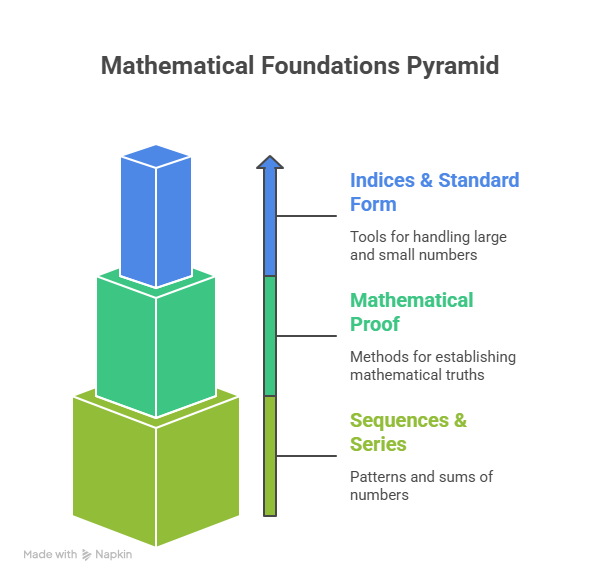
Number, Proof & Sequences
Proof transforms “I think” into “I know.”
This part of the syllabus builds intellectual discipline — every claim must stand on logic, not luck.
Core Ideas
Proof by Contradiction: Assume the opposite and watch it collapse.
Counterexamples: One wrong case can destroy a universal rule.
Sequences: Arithmetic and geometric progressions, sigma notation, infinite series.
Error & Bounds: How small rounding slips ripple through calculations.
💡 Mini-Proof: Assume √2 is rational, write it as p/q in lowest terms → both p and q turn out even → contradiction. Hence, √2 is irrational.
Explore: Grammar school exam preparation: 3 simple steps every UK student must know
Coordinate Geometry & Circles
If algebra is logic, geometry is poetry.
Further Maths extends GCSE coordinate work into elegant problems about gradients, chords, and tangents.
Line Equations: y=mx+cy=mx+cy=mx+c, midpoints, perpendicular bisectors.
Circles: Standard form (x−a)2+(y−b)2=r2(x-a)^2+(y-b)^2=r^2(x−a)2+(y−b)2=r2.
Tangents: Gradient × radius = −1.
Applications: Distance formulas in 2D proofs or motion problems.
📎 Learn more at BBC Bitesize – Coordinate Geometry.
Trigonometry – Angles, Identities, and Imagination
Trigonometry in Further Maths is less about triangles, more about patterns.
You’ll manipulate sine and cosine like algebraic tools.
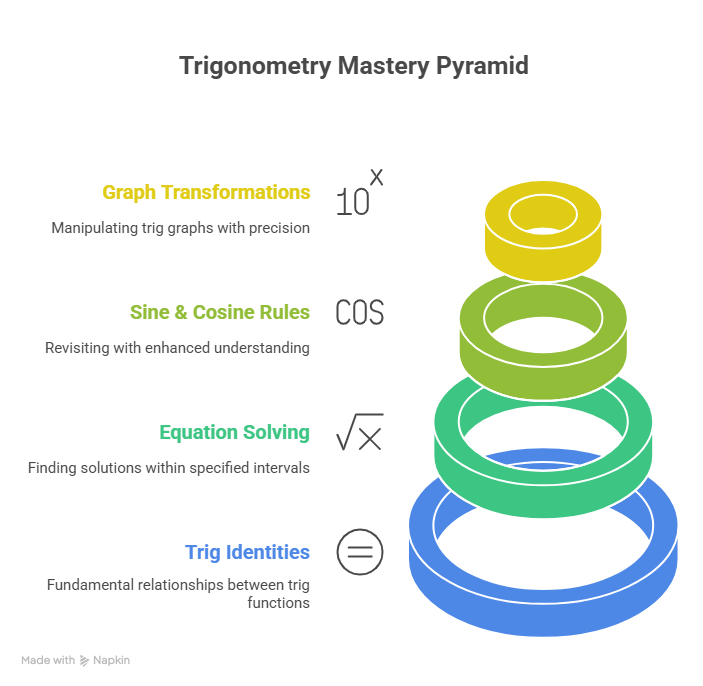
You’ll Learn
Trigonometry identities:
Solving equations: within 0°–360° or 0–2π.
Sine & Cosine rules: revisit them with new rigour.
Graphs: amplitude, period, and phase shift transformations.
Vectors & Matrices – The Geometry of Motion
Matrices and vectors appear magical at first — symbols that somehow move entire shapes.
But they’re the real-world backbone of computer graphics, robotics, and engineering.
Once you see matrices turn coordinates into reflections or rotations, you’ll realise maths isn’t abstract—it’s cinematic.
Calculus – Watching Change Happen
Calculus is the show-stopper: it turns static curves into living motion.
Core Concepts
Differentiation: slopes, tangents, optimisation.
Integration: area under a curve, anti-differentiation.
Limits: intuition about approaching values.
Applications: velocity, growth, economics, and even biology models.
📘 Example: Differentiate y=x3y=x^3y=x3 → 3x23x^23x2.
Instantly, you know how the curve changes at every point.
Probability & Statistics – Measuring Uncertainty
Probability in Further Maths goes deeper than rolling dice — it’s about structure and logic.
Permutations & Combinations: counting the unseen.
Binomial Distribution: probability of k successes in n trials.
Data Measures: mean, median, variance, standard deviation.
Graphs & Interpretation: identifying bias, outliers, and trends.
Transformations & Matrices in Geometry
A powerful crossover of algebra and art.
Matrices become visual tools: rotate, reflect, enlarge — all via simple numbers.
Problem-Solving & Modelling Techniques
This is where it all fuses. You’ll translate word problems into algebraic structures and reason through unknowns.
Example Scenario:
From this, you can predict stopping times at various speeds — maths turned into foresight.
Calculator vs Non-Calculator Skills
In exams, about half your marks rely on pure reasoning.
Practice writing exact answers using surds, fractions, and π where possible.
✅ Quick Tips
Show every algebraic step.
Carry exact values until the final line.
Don’t rely on calculator graphs—draw by hand for intuition.
Exam Strategy & Common Pitfalls
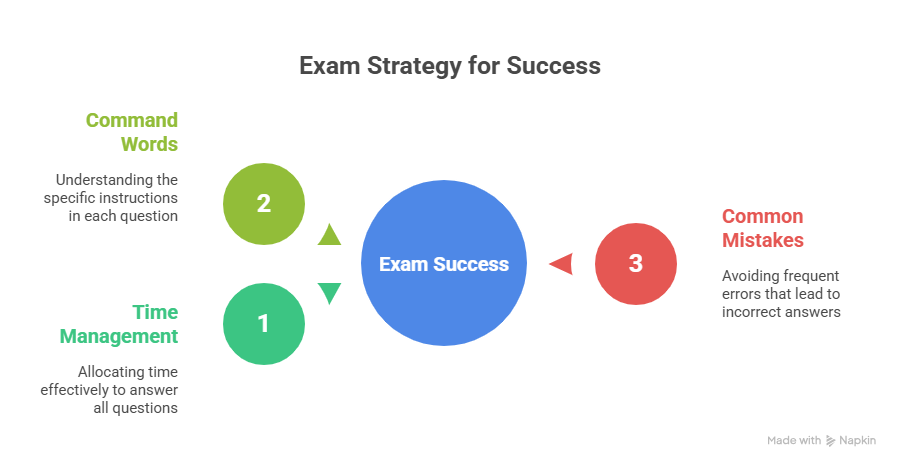
Time management wins papers.
Allocate minutes by marks: one mark ≈ one minute.
Read command words carefully—prove, show that, deduce, hence—they tell you how much reasoning to display.
Frequent Mistakes
Dropping negatives.
Mixing radians with degrees.
Rounding too early.
Forgetting domains in inverse functions.
👉 Also read: How to Pass GCSE Maths: The Complete, No-Stress Study Blueprint
8-Week Study Plan Template
Next Steps – Bridging to A-Level Maths
By now, topics like differentiation, functions, and proofs should feel familiar.
That comfort will make your A-Level transition smooth.
If you can already manipulate algebra efficiently and grasp calculus intuitively, you’re halfway through the first term before it starts.
💡 You might also like: The Ultimate Guide to Creating a Revision Timetable That Actually Works
FAQs
Final Thought: Build the Confidence Behind the Calculations
GCSE Further Maths is more than just equations; it’s about discipline, logic, and perseverance.
At Suited Tutor, we empower students to master every topic through personalised lessons, mock exam simulations, and practical problem-solving.
🎓 Ready to turn your Further Maths challenge into a strength?
Join hundreds of GCSE students who’ve achieved Grades 8–9 through our tailored 1:1 guidance and structured study plans.
Whether you’re aiming for Grade 9 or preparing for A-Level Maths, we’ll help you move from learning formulas to thinking mathematically.